



AI in Education
Most people don’t realize that teachers have used AI tools like the plagiarism detection software Turnitin to identify student cheating and automated grading applications on platforms like Google Classroom for years. But since OpenAI introduced ChatGPT in November of 2022, the explosion of generative AI bots such as ChatGPT and Google Gemini has brought controversy to the role of artificial intelligence in schools. The technology has the potential to upend education, the labor market, and our economy. Generative AI is a type of artificial intelligence that creates completely new content such as text, sound, image and video from prompts, based on existing data patterns. In the education system, a debate is swirling as to whether generative AI is destructive or beneficial to learning. It would be reductive to say AI is “just bad” or “just good.” Some students feel that AI genuinely enhances their learning. And some teachers utilize AI to lighten their workload. But can AI be ethically used by students? Can any AI use even be called ethical, given its potential for environmental harm? How can we differentiate between students learning from AI versus students using AI to avoid learning?
Most MBHS Students Use AI in Some Form
We conducted a series of interviews that provided valuable insight on how AI is influencing academic performance and student engagement at Millennium Brooklyn. Ella Russell, a tenth grader, explained that she only uses AI as a last resort for “homework [she] doesn’t understand to double check that everything’s right.” She clarifies, “I don’t use it to do my work,” adding that AI doesn’t meaningfully enhance education the way teachers do. She asserts that it should never be used to plagiarize. Gianna McIntosh, a 10th grader, states she does not use AI for school work at all. But, she explains, “I use it for debate […] helping me write my script.” And she only uses the technology to “help me enhance [my ideas], not to think for me.” She believes AI can be used in beneficial ways when used to strengthen your understanding but is not always a necessary tool.
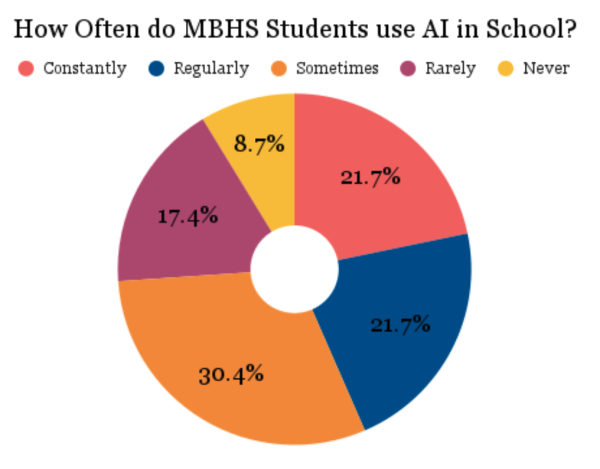
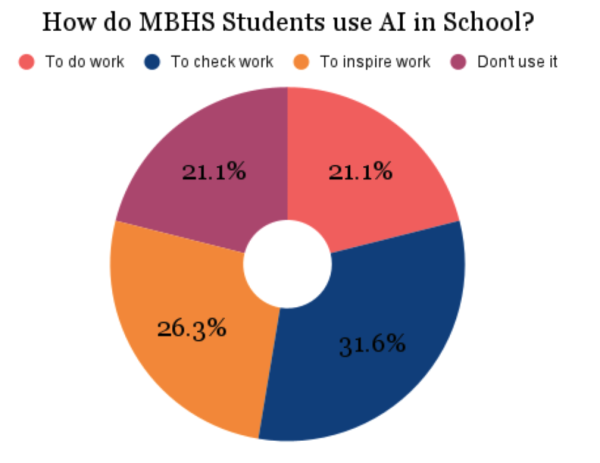
Additionally, we formulated an anonymous poll asking students to share how often and in which ways they used AI as a tool. 30.4% of students surveyed claim to use AI “Sometimes” at MBHS. However, a larger proportion reported using AI “Regularly” or “Constantly” with 21.7% of students surveyed reporting both usage levels. This may seem worrying at first, but how the students use the technology provides us with greater insight into these responses. While 21.1% of the students we polled do not use AI in school, 57.8% report using it in ways we might classify as “beneficial”: to check their work or provide inspiration. Concerningly though, 21.1% of students who responded reported they use AI to do their work for them. Although most of the students we surveyed believe plagiarizing with AI is unethical, one in five does not.
MBHS Teacher Perspective
10th and 11th grade Algebra II teacher Ms. O’Neal does not use AI in her class. She claims “in math, it’s a little harder because you can ask it to generate questions, but sometimes those questions are no better than the questions I would come up with myself.” However, she has “found that ChatGPT can come up with some really helpful ideas efficiently for lesson structures.” Although she has never used AI for that purpose, she acknowledges it might be beneficial in that way especially for newer teachers. Additionally, she recognizes that students commonly use AI to do their online Deltamath homework so she implements “Homework Checks,” small quizzes, to make sure students actually understand what is going on in class.
9th grade humanities teacher, Dr. Rippeteau barely uses AI for teaching purposes, only turning to generative AI to reword questions so students can better understand the answers she seeks. Even then, she doesn’t feel that AI takes its audience into consideration and that “it doesn’t come up with anything that’s any better than what I can come up with in my brain,” she says.
Rippeteau is aware of the rapid progression of AI, saying “I know for a fact that [students] do [use AI]” and to combat that, she does multiple in-class timed writing assignments “to see their writing in its rawest state.” As Rippeteau states, “Oftentimes, when typed, [students] suddenly have a vocabulary that they did not have when they were writing on demand. So I recognize that writing, but this writing, what the hell is this?” When asked about the major tells of AI use, Dr. Rippeteau reveals that other than her students’ unexpectedly enhanced vocabulary, she can also see from the teacher side of Google Docs when students type line by line versus from when they copy and paste. Rippeteau addresses that “pasting doesn’t always mean [the work is] bad, but then all of a sudden when [I see] a copy and paste of a big chunk of text, [I’m] like, what is that?” This year, five of her students failed their The Leavers essay for plagiaristic reliance on AI. Ultimately, Dr. Rippeteau finds the exponential use of generative AI in her class to be extremely problematic.
In contrast, AP U.S. History teacher Ms. Senat has a more optimistic take on AI use in school. In her teaching, Senat relies on AI to avoid repetitive processes by using it to “to brainstorm lesson plan ideas, generate practice questions, fine-tune language for student-facing slides or worksheets, and help streamline grading.” Ms. Senat feels that using AI allows her to focus on teaching and to connect with her students. As AI is already a part of many people’s everyday lives, Ms. Senat believes instead of AI being “something to fear or ban outright, […] the focus should be on using it responsibly and thoughtfully.” But, it’s important to note, she “always checks over the work and adjusts everything,” acknowledging it’s not a replacement for her professional judgement. Regarding her students, Senat finds generative AI use fairly common, but acknowledges that AI-generated work is not always obvious to identify. Because of this, she’s made the decision to not grade anything that her students do at home, but instead “grade only work done in the classroom that [I] can be sure is their own.” When she does observe noticeable plagiarism, it’s often given away by unusual patterns in her students’ writing that don’t match their typical voice. However, when used correctly–to support thinking instead of replacing it–she finds that students can benefit from AI, through the additional explanations and perspectives it provides.
Impacting Education
AI certainly has benefits for educators and students. Using AI, teachers are able to generate new ideas, seek out information, and check for errors in their own presentations. Teachers can make lessons more appealing to students with AI mods and save time on their lesson plans. Not only can teachers use AI for teaching, but the use of AI can be expanded to grading as well. Teachers can use AI detectors like ZeroGPT to see if students have used AI and use AI tools to grade students’ work.
Students can use AI to help with studying and to receive feedback which could enhance their learning in subjects they struggle on. A student can also benefit by searching for recommended strategies to improve focus, or for ideas on how to catch up on missed lessons. Although AI has many potential educational benefits, it seems inevitable that some students will take advantage of the opportunity to use it to do their work. This can impact their learning by making them unmotivated during lessons, decreasing their cognitive ability to learn and develop competency for doing challenging work.
Foreseeing the future
As AI is rapidly evolving, and continuing to have impacts on the education system, what will the future look like in schools? Will teachers be replaced by AI? Will students become fully reliant on AI? Although we know nothing for certain, there are ways educators can use AI to their advantage as the use of it progresses. We are well aware most students already use AI in their studies and it is determined AI will be implemented in many workplaces in the future. Instead of ignoring this issue, teachers can provide ways to use AI responsibly. Introducing AI into classrooms early should lead to students using the tools in responsible ways as opposed to using the technology blindly for plagiarism purposes. AI tools can help create ideas, give instant feedback, and overall attend to a student’s individual needs, skills teachers may need assistance with. Teachers can also engage in the world of AI, building on their lesson plans, identifying places students need help and helping to create specialized study plans for students. The reality is, AI is going to be a part of our futures, so understanding how to use them responsibility will empower students with the skills they need to thrive and be successful.