
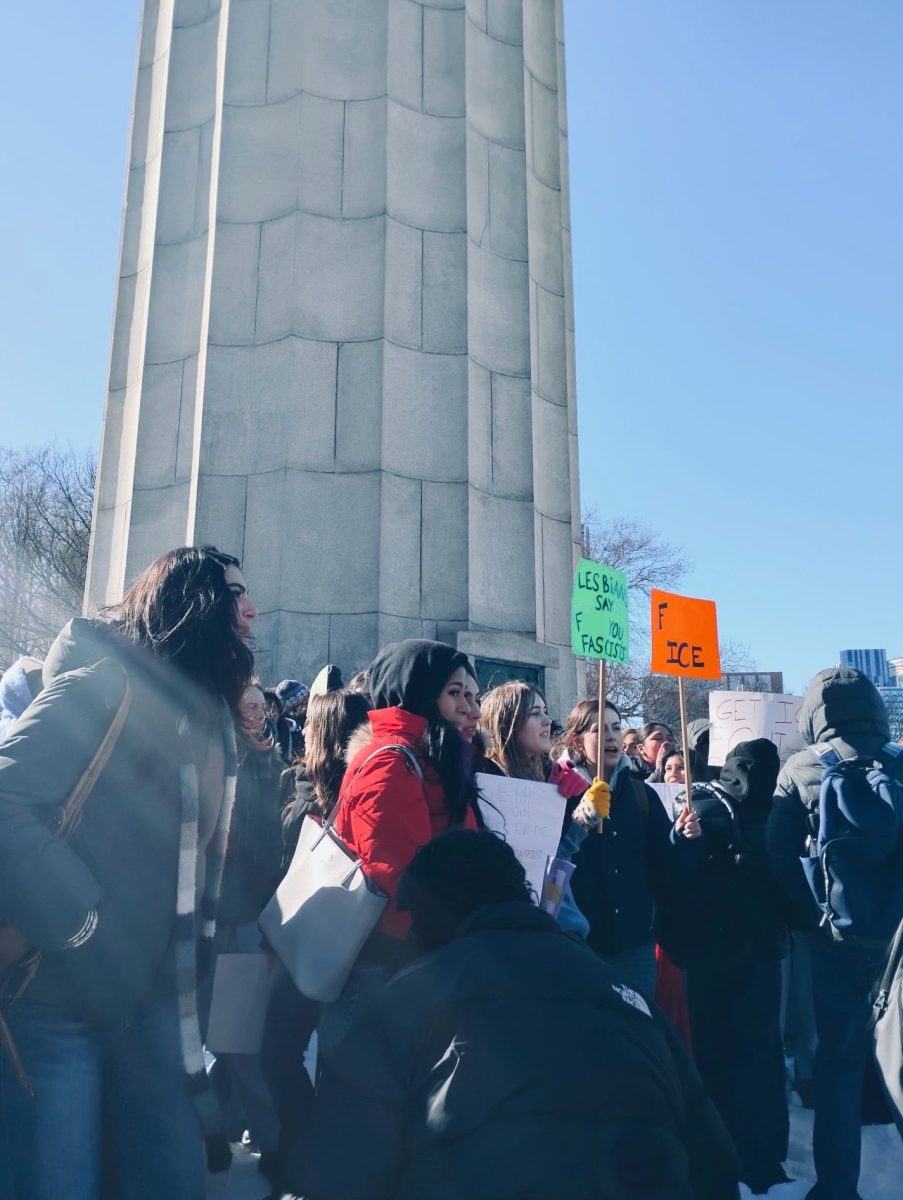
On the cold, snowy, sub-freezing streets of Fort Greene, a large gathering of students from Brooklyn Tech and Millenium Brooklyn marched, holding signs and chanting in solidarity: “NO ICE! NO KKK! NO FASCIST USA!” The students had gathered on January 30th in conjunction with a planned “national strike.” Activists in Minneapolis, still reeling from the murders of Renee Good and Alex Pretti, had called for the action in defiance of the federal government and word of a nation-wide protest had spread over the internet. Alongside my MBHS peers, I joined in the school walkout to protest against Immigration and Customs Enforcement’s actions in Minneapolis and across the United States. The participating students expected their actions would resonate as part of a nationwide movement opposed to the events in Minnesota; many in the group charged on from Brooklyn to unite with a broader protest at Foley Square. However, reading the news the next morning, those of us who marched would see almost no mention of the action we had taken, prompting the question, what mark had we really made?
I certainly do not regret participating in the protests, but, in the intervening weeks, I have been wondering, what did we actually accomplish? I am preoccupied by the thought that we, as a school and as a country, can do better.
Lest I be seen as condemning the protests, I do want to reaffirm my support of the walkout. I joined due to my personal beliefs opposing the violent anti-immigrant acts conducted by the Trump administration. But I think bolder tactics and strategies are necessary to make the messaging more effective. One way to achieve that might be to model our actions on other successful protests such as the October 2025 No Kings Protests, which saw an estimated 5 to 7 million participants march in opposition to the Trump agenda. Another successful model is the Minneapolis General Strike, which unfolded on January 23rd. At that event in Minneapolis, 75,000 people marched in the streets. And, according to Blue Rose Research, one in four Minnesota voters participated in an economic shutdown intended to eliminate ICE from their state. Both of these protests were aligned in mission and vision to the student walkout, but were clearer in their aims and far more successful in garnering national attention to their cause.
If you witnessed the student hordes marching through Fort Greene on the 30th of January, you might have been impressed with how large of a crowd participated. We arrived to Fort Greene Park to join Brooklyn Tech contingent, the crowd hovering somewhere around 100 students. The Brooklyn Daily Eagle had reported 500 Brooklyn Tech students walking out earlier that day, though many had returned to their building by the time of our arrival. Differing reports on the intended start time of the protest had delayed the arrival of many Millennium participants. Additionally, police officers had directed to move to the park from its original location near Barclays Center; hence, many Tech students returned to school at that time.
Despite the foibles in planning, the students present made their voices heard: they hoisted signs and chanted and formed human chains in the park despite temperatures in the teens. Wikipedia, which was the only site to even record the nationwide events in any meaningful capacity, still dismissed the day’s protests as “never materializ[ing].” The site also notes that none of the strike’s stated goals of nationwide financial shutdown were achieved, and asserted that the student protests did not even breaking the major news cycles. So, what was the point of it all? Why did we bother?
On Monday, January 26th, several student unions at the University of Minnesota had called for a second general strike in Minneapolis in response to the brutal shooting of Alex Pretti on the day following. The initially localized strike was grew into a national one as several small unions picked up the idea. “No School, No Work, No Shopping” was the tagline pitched by various organizers. As news of the strike spread across Instagram and eventually to my Thursday Foundations Of Research class, I heard another student mention their interest in participating.
While the grassroots organizing and the strike appear to have been effective locally in Minneapolis–the administration agreed to draw down its ICE presence in Minneapolis following Pretti’s murder, the strike appears to have had less impact nationally.
For these issues, I blame poor planning. Viral instagram posting statements on social media and one appearingly central website explaining plans that only really touched on school walkouts served as the only standard messaging. This disorganization drew many people away from the protests with many people wondering about the “no shopping” angle as they were wondering if that did not include immigrant businesses or if the intention was a full halting of the economy, even for the people they protested to support.
While many would argue that most political figures wouldn’t support the protests in the first place , something should taken from the fact that, according to my research, the actor Pedro Pascal and the singer and actress Ariana Grande were the only notable supporters of these specific protests before the day itself. Notably, Ilhan Omar, the vocal representative from Minnesota and noted participant in that city’s protests, did not announce the protest beforehand via social media or to her constituents. Similarly, Zohran Mamdani, though a strong opponent of ICE, did not not call on his supporters to participate. (Mamdani would make a tweet supporting the strike around noon, after many of the protests, including ours at Millenium, had already began). I think that if the messaging by the organizers had been stronger in advance, politicians like Omar and Mamdani might have gotten on board earlier and leveraged their influence to draw greater attention to the students taking action.
As for the potential for real impact, we can see an illustration for that in the protest that took place in Minneapolis on January 23rd, the “Day of Truth and Freedom.” Hundreds of businesses closed in solidarity, making a clear economic mark that travelled all the way to Trump and the White House. While the protest in New York suffered from a lack of organization and cohesive messaging, Minnesota showed up and showed out and the actions of protestors there had an impact.
As someone who wants our protests to succeed, I have thought of how our actions can be expanded. While the walkouts undoubtedly create a spectacle to those who witness them, few outside of schools notice them. However, if we held protests on a weekend for example, people from students to teachers to any sort of city resident could easily participate, expanding the protests at the expense of a small in-school spectacle. For example, all iterations of the No Kings Protests, which have had 4, 7, and 9 million attendants respectively, occurred on Saturdays to accommodate those who were busy during the week. I would also suggest that politicians who support protests should personally input plans, for example, if Mamdani was to advertise a specific location and time for protests, the word could be spread far easier than many competing plans. The No Kings protests also had many organized rallies with speakers, which would hugely benefit turnout if the persons prevalent were of particular note. With these thoughts, that have hopefully accumulated amongst many in the passing months, protest movements in MBHS and across New York can carry out more successful actions in the future and reach a larger audience with their cause.
Lastly, I want to touch on what we did that worked. While it might, on surface, appear superfluous for hundreds of students to proudly march through an empty park at noon, for those of us who were there it was an uplifting experience in solidarity, with positive feelings permeating the crowd. After we left the park, we passed down Atlantic Avenue in Boerum Hill and a lot of the business owners (many of presumably immigrant-run businesses) came outside to cheer us on. That feeling of solidarity has stuck in my head since that day as a moment of success and a sentiment that we can build upon.